
★
★
★
★
★
It's giving the Ferrari of racquet games!"Tori Fitzpatick, Influencer

Official Duel goods
Couldn't load pickup availability
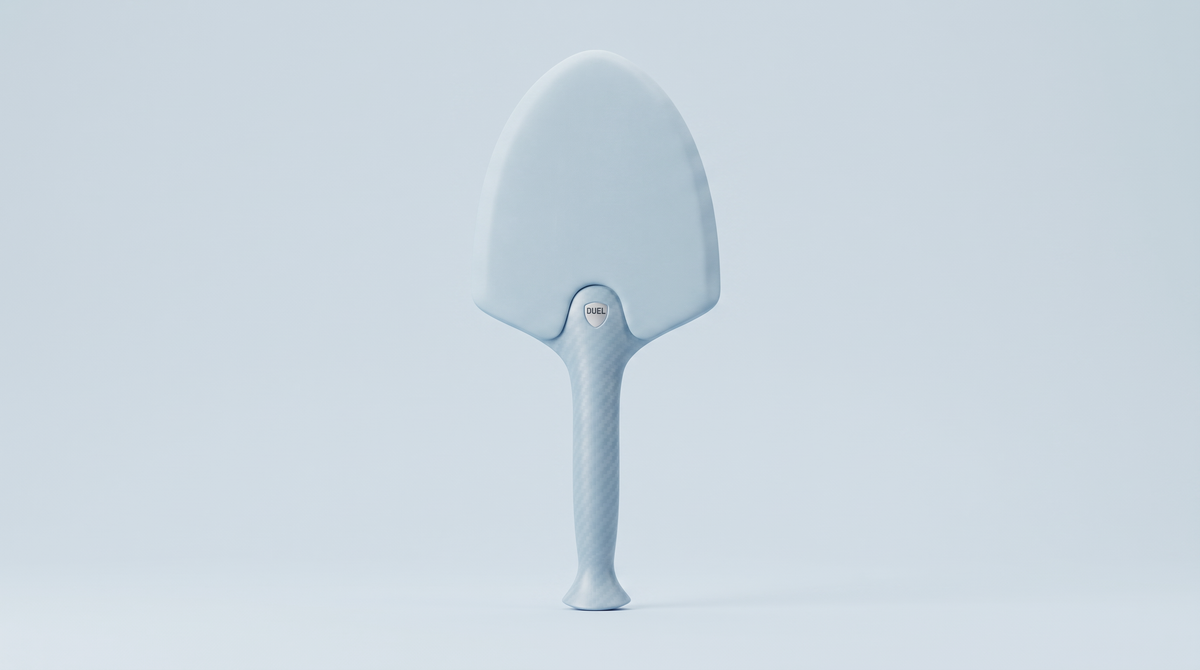
Duel 1509 Racquet | 160gms | carbon fibre | leather bound shield surface | Air blue | designed in England.
Pre-order new 2027 edition - in stock from 15 12 26
5 THINGS MOST PEOPLE LOVE ABOUT DUEL
1. 15 mins 09 secs to complete a Duel means it easily fits into your day.
2. Minimalist, feather-light Duel racquet design makes it a pleasure to have it with you.
3. Duels take place anywhere as we know you're not a fan of booking and planning.
4. High level of exhilaration continues to hit you from the moment you draw your Duel racquet and start striking the shuttle upwards at your opponent's torso, so no boring moments or downtime - literally.
5. Duel's 15 seconds to learn rules means new opponents are ready instantly - complexity be gone.
DUEL RACQUET DESIGN
Every racquet ever made has, in theory, the power to extend human life by five to ten years and make its owner look and feel incredible. The research on this is extensive.
Yet most racquets lead remarkably uneventful lives. They are used perhaps once a year, before retreating to a dark Harry Potter style cupboard under the stairs.
Duel was designed to change that.
Rather than treating the racquet as a piece of sports equipment, Duel approaches it as a luxury accessory: something you want to own, carry and have within reach. The premise is simple. If you make the object desirable enough, perhaps it will get used more.
The racquet's distinctive shield-shaped upper section quietly references the college shields of Cambridge University, where Duel's development team, led by two female founders, is based. Below it, elegantly muscular sections connect the upper form, drawing on the extraordinary silhouette of ballerina Anna Pavlova's neck as she looks towards the sky in The Swan.
These references are deliberately subtle. They are embedded within a single object rather than announced on its surface.
The result is a solid carbon-fibre and leather racquet that weighs roughly the same as an iPhone and occupies approximately the cubic volume of a mini iPad.
But nobody needs to know any of these design secrets to enjoy using the racquet.
They simply grip it and discover the pleasure of the thwack: the arm accelerating from zero to 150 mph in less than a second as the Duel shuttle travels towards an opponent's torso, before being returned and sent back again.
For Duel, however, designing the racquet was only half the challenge. If the racquet was going to become a treasured possession, it needed a sport that people could actually play.
Traditional racquet sports come with friction. You need a court. You need to book it. You need to travel there. You need enough time to justify going.
Duel removes almost all of that.
A Duel requires just three square metres and can take place almost anywhere. Duels have already appeared on the streetwear floor of Selfridges, in front of the Duomo, and on the rooftop of the headquarters of one of the world's most sought-after matcha brands.
The sport is deliberately time compact, too. A Duel lasts just 15 minutes and 9 seconds—a duration designed around the minimum World Health Orgnaization threshold for daily fast physical activity.
What began as a study in making a racquet more desirable has therefore become something larger: an attempt to redesign the conditions around sport itself.
Three hundred years ago, Duels were associated with aristocratic conflict and ending of life. Perhaps they now can help us continue it.
duelsociety.org
It's giving the Ferrari of racquet games!"Tori Fitzpatick, Influencer
I could Duel all dayMarisa Poster, Founder Perfectted
Such a cool way to do a 15 minute nugget of exercise and get your heart rate upSunna van Kampen, Founder Tonic Health